The Most Perfect Title of All Time
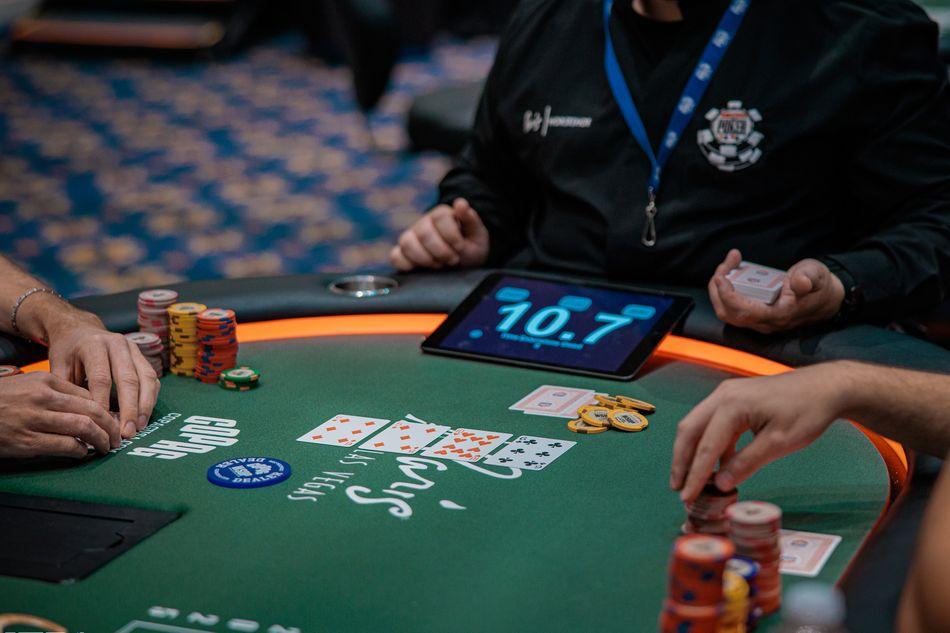
Why a Poker Tournament Clock Is a Game Changer for Any Poker Night
There is a point in almost every poker tournament where someone asks the same question:
“How much time is left in this level?”
Then someone checks a phone. Another player asks what the next blinds are. Someone else wants to know when the break starts. A player at the other table cannot hear the announcement. The tournament organizer is trying to play a hand while simultaneously answering questions, tracking eliminations, managing rebuys, and remembering when to increase the blinds.
For a casual game with six friends, maybe that works.
For anything bigger, it quickly becomes chaos.
That is exactly why a poker tournament clock can be one of the biggest upgrades you make to a home game, poker league, charity tournament, bar league, or professional poker room.
A good tournament clock does much more than count down from 20 minutes. It creates structure, improves the player experience, reduces mistakes, and makes an event feel dramatically more professional.
Here is why it can be a game changer.
Everyone Knows Exactly What Is Happening
The most obvious benefit of a poker tournament clock is visibility.
At any moment, players should be able to see:
- The current blind level
- Time remaining in the level
- The next blind level
- Current ante
- Upcoming break
- Number of players remaining
- Average chip stack
- Prize pool information
Without a central tournament display, that information is usually scattered across a spreadsheet, a notebook, someone’s phone, or simply the tournament director’s memory.
That creates unnecessary confusion.
A large, easy-to-read clock gives every player the same information at the same time. Nobody has to interrupt the game to ask whether the blinds are 500/1,000 or 600/1,200. Nobody has to shout across the room asking when the next break begins.
The tournament becomes easier to follow because the clock acts as the event’s central source of truth.
It Instantly Makes a Tournament Feel More Professional
Players notice presentation.
You can have great tables, quality chips, talented dealers, and a carefully designed structure, but if someone is running the blinds from the stopwatch app on their phone, the event can still feel improvised.
Put a polished tournament clock on a television or large monitor and the entire atmosphere changes.
Suddenly, the game looks organized.
It feels intentional.
It feels like an event.
This matters even more for poker leagues, charity tournaments, corporate events, poker clubs, and card rooms. Players often judge the quality of an operation based on dozens of small signals. A professional tournament display is one of those signals.
It tells players:
We planned this. We know what we are doing. Your experience matters.
That perception can have a real impact on whether people return for the next tournament.
The Tournament Director Can Actually Focus on Running the Tournament
Running a poker tournament is harder than it looks.
The person in charge may need to:
- Handle late registrations
- Process rebuys and add-ons
- Balance tables
- Move players
- Track eliminations
- Answer rules questions
- Calculate payouts
- Update standings
- Manage breaks
- Resolve disputes
- Announce blind changes
And in many home games and poker leagues, the tournament director is also trying to play.
A tournament clock removes a surprising amount of administrative burden.
Instead of constantly watching the time and announcing every level change manually, the system can handle the progression of the tournament. The organizer can see exactly where the event stands and focus on higher-value decisions.
That becomes especially important as tournaments grow.
A 10-player tournament may be manageable with a phone timer.
A 30-player tournament is different.
A 75-player charity event is completely different.
The larger the event becomes, the more valuable centralized tournament management becomes.
Blind Changes Become Consistent and Fair
Poker players care about fairness, and they should.
When tournament levels are managed manually, small inconsistencies can creep in.
Maybe one 20-minute level accidentally lasts 23 minutes.
Maybe the tournament director is involved in a big hand and forgets to increase the blinds.
Maybe one table hears the blind change immediately while another table does not.
These mistakes are rarely intentional, but they can still affect the tournament.
A proper tournament clock creates consistency.
When the level ends, the level ends.
Every player is operating under the same structure. Everyone can see the countdown. Everyone knows what is coming next.
That predictability improves trust in the event.
Players Can Make Better Strategic Decisions
A tournament clock is not only useful for the organizer. It gives players important strategic information.
Imagine there are three minutes remaining in a level and the blinds are about to double.
That matters.
A short stack may decide to take a more aggressive opportunity before the increase. A big stack may adjust pressure based on the approaching blind level. A player considering a rebuy may want to know how much time remains before registration closes.
Tournament poker is heavily influenced by structure and timing.
When players can clearly see the current level, next level, time remaining, and average stack, they can make better-informed decisions.
That makes the tournament more engaging because players are not simply reacting to their cards. They are thinking about the event as a whole.
Breaks Become Easier to Manage
Anyone who has organized a live poker tournament knows that breaks can become surprisingly messy.
Players want to know:
“When is the break?”
“How long is the break?”
“Are we coloring up chips?”
“When does registration close?”
A tournament clock can communicate all of this.
Instead of repeatedly answering the same questions, the organizer can display an upcoming break and automatically transition into a break timer.
Players know exactly how much time they have before cards are back in the air.
That reduces delays and helps keep the tournament on schedule.
Multi-Table Events Become Much Easier
A tournament clock becomes even more valuable when a game expands beyond one table.
At a single table, the organizer can simply announce a blind increase.
Across three, five, or ten tables, communication becomes much harder.
Some players may not hear the announcement. Dealers may receive information at different times. A table in another room may continue playing the previous blind level.
A shared tournament display solves much of that problem.
Even better, a modern web-based poker tournament clock can potentially be displayed across multiple devices.
That means the primary clock could be shown on a television while players also view tournament information from a phone, tablet, or secondary screen.
The tournament is no longer dependent on everyone being able to see one physical display.
It Creates the Foundation for a Better Poker Experience
The real power of a tournament clock appears when it connects with the rest of the poker experience.
Imagine a tournament system where the clock works alongside:
- Player registration
- Online RSVPs
- Table assignments
- Rebuy tracking
- Add-on tracking
- Prize pool calculations
- Player eliminations
- League standings
- Season points
- Notifications
- Tournament history
Now the clock is no longer an isolated timer.
It becomes the live operating center of the tournament.
A player gets eliminated, and the player count updates.
A rebuy is recorded, and the prize pool changes.
The field gets smaller, and the average chip stack automatically recalculates.
The tournament ends, and results flow directly into league standings.
That is where poker technology becomes truly powerful.
A Better Tournament Clock Means Less Chaos and More Poker
At the end of the day, players showed up to play poker.
They did not show up to repeatedly ask about blinds, breaks, payouts, or how many players remain.
Tournament organizers did not start a league because they wanted to spend the entire night updating spreadsheets and setting alarms on their phones.
The best technology disappears into the experience.
It quietly handles the repetitive work, keeps everyone informed, and lets the people in the room focus on the game.
That is why a poker tournament clock can be such a game changer.
It brings structure to the tournament.
It improves fairness.
It reduces confusion.
It gives players better information.
It makes organizers more effective.
And perhaps most importantly, it can transform an ordinary poker night into something that feels like a real event.
Whether you are running a monthly home game, a growing poker league, a charity fundraiser, or a full-scale poker room, a modern tournament clock is not just a nice visual upgrade.
It can become the heartbeat of the entire tournament.
Run your next poker night with RebuyLabs
Live tournament clock, buy-ins, payouts, and league standings — free to start.
Get started free